
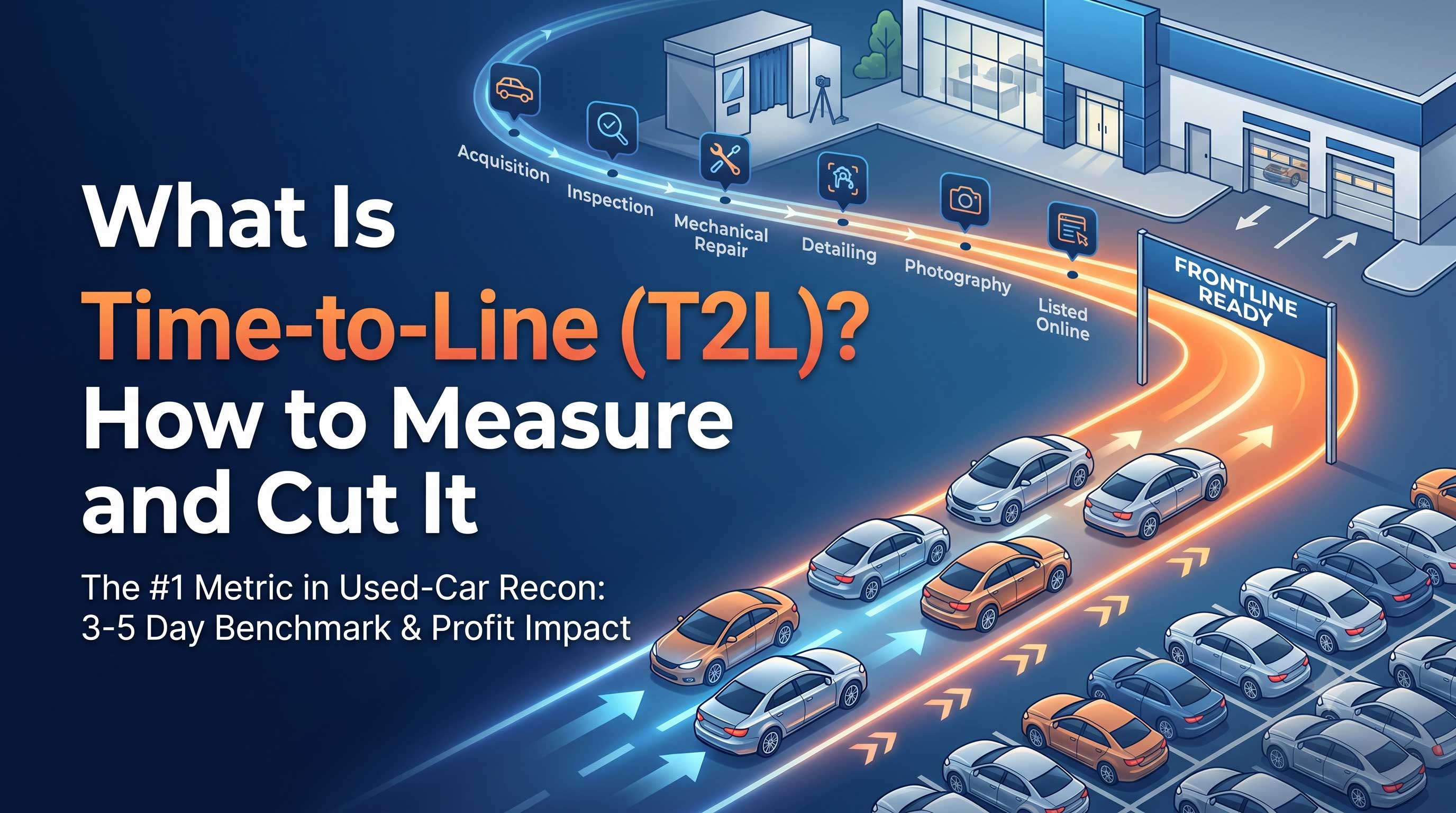
Time-to-line, or T2L, is the number of days it takes to move a used vehicle from the moment you acquire it to the moment it's frontline ready and listed for sale. It's the single most important metric in a used-car operation, because it controls the two things that decide whether the department makes money: how fast your capital recycles, and how much a car depreciates before it ever gets a price tag.
If you only track one recon number, track this one. Here's exactly what it measures, how to calculate it, what a healthy number looks like, and how to bring yours down.
What time-to-line actually measures
The clock starts when the vehicle becomes yours: the day it's bought at auction, taken in on trade, or returned off lease. The clock stops when the car is frontline ready, meaning priced, photographed, listed online, and parked on the front line where a shopper can actually find and buy it.
Two things trip dealers up here.
Where the clock starts. Some stores start counting at acquisition, others at physical arrival on the lot. Pick one and stay consistent, but know that days a car spends in transit are still days it isn't selling. Starting the clock at acquisition gives you the honest number.
Where the clock stops. "Mechanically done" is not the finish line. A car that's repaired but not photographed and listed is invisible to every shopper online. T2L ends when the car is genuinely for sale, not when the service department is finished with it.
You'll sometimes hear this called time-to-market. Same idea, same clock.
How to calculate time-to-line
For a single vehicle, it's simple subtraction:
T2L (days) = date the car went frontline ready − date the car was acquired
For the department, you average it across the vehicles you complete over a period:
Average T2L = total recon days for all vehicles ÷ number of vehicles completed
For example, if you finished ten cars this month and they took 80 recon days between them, your average T2L is 80 ÷ 10, or 8 days.
Track two layers, not one. The overall average tells you whether you have a problem. The time each car spends in each individual stage tells you where it is. Most dealers only watch the average, which is like knowing your team is losing without knowing the score by quarter.
What a good time-to-line looks like
Best-in-class dealers get cars frontline ready in 3 to 5 days. Plenty of stores run 10 to 15, and plenty of independents have no idea what their number is because nobody has ever measured it.
T2L ties directly to inventory turn. A used-car operation turning its inventory a healthy 10 to 12 times a year needs cars hitting the line fast. The national average sits closer to 6 turns. Every day you cut off T2L is a day earlier the car can sell, which means your capital comes back sooner and you can buy and turn more units with the same money.
So the target isn't a vanity number on a dashboard. A 3-to-5-day T2L is what makes a double-digit turn possible in the first place.
What a slow T2L actually costs
Here's the math that should make you care.
Holding a used car costs somewhere between $40 and $85 a day once you add up flooring, depreciation, insurance, and the rest. Call it $60 to keep it simple.
Now take a store running a 12-day T2L that gets it down to 5. That's 7 days saved on every car. At $60 a day, that's $420 back on every single unit.
Run 100 used cars a month through recon, and that 7-day improvement is worth roughly $42,000 a month. That's north of half a million dollars a year sitting in the gap between a 12-day and a 5-day T2L.
That's why T2L is the number. It isn't a process metric, it's a profit metric.
What actually drives your time-to-line
When T2L is high, the instinct is to push the techs to work faster. That's almost always the wrong lever.
As we broke down in the recon process, step by step, the days don't disappear into the work. They disappear into the waiting between the work. A car that takes 11 days to hit the line might have 6 hours of actual hands-on time in it. The rest is dwell time: sitting in an approval queue, waiting on a part, parked between stages because nobody knows it's ready for the next person.
Touch time is rarely your problem. Dwell time almost always is. So the way to cut T2L is to attack the gaps, not the tasks.
How to cut your time-to-line
Measure every stage, not just the total. You can't fix a bottleneck you can't see. Break the average into per-stage times and the problem usually jumps right out: two days dead in approval, three days waiting on parts.
Put a clock and an owner on every step. Dwell time thrives when nobody owns the wait. When a car has been sitting 36 hours in one stage, someone should be accountable and someone should be notified.
Approve faster. Approval is one of the most common hidden delays, and it's nearly free to fix. A same-day or mobile approval rule keeps cars from dying in a manager's inbox.
Run vendor work in parallel. A car waiting on parts can also be getting PDR, glass, or interior work at the same time. Sequential is slow. Parallel is fast.
Automate the handoffs. The single biggest source of lost days is the "is that car ready yet?" gap between stages. When finishing one step automatically alerts the next person, cars stop sitting.
Review your aging units daily. A two-minute look at the oldest cars in recon catches the ones that have stalled, before they quietly become 20-day problems.
The mistakes that keep T2L high
Gaming the number. When T2L becomes the only thing leadership watches, people learn to manage the metric instead of the car: excluding units, or shuffling cars between steps to keep the clock clean. You get a pretty number and the same slow process. Measure the cause, not just the score.
Only watching the average. A fleet average with no per-stage detail tells you that you have a problem but not where it lives. Always drill down.
Chasing wrench time. Pushing a tech to shave minutes off a 6-hour job does nothing about the 10 days of waiting wrapped around it.
Where Cartuul fits
Cartuul was built to attack the exact thing that drives T2L: the dwell time in the handoffs. It tracks the time every car spends in every stage, surfaces the gaps the moment they open up, and automates the step-to-step handoffs so nothing sits while everyone assumes someone else has it. The T2L number comes down because the process actually got faster, not because someone tidied up the board. It's the same system Mike Murphy Ford uses to manage roughly 800 vehicles in recon. See how it works.
Frequently asked questions
What is a good time-to-line? 3 to 5 days is best-in-class. Many stores run 10 to 15. The gap between them is almost entirely dwell time, not work.
How do you calculate time-to-line? Subtract the acquisition date from the frontline-ready date to get a per-vehicle number, then average that across the vehicles you complete in a given period.
What's the difference between time-to-line and inventory turn? T2L measures how fast one car gets ready to sell. Turn measures how many times your whole inventory cycles in a year. A faster T2L feeds a higher turn, because cars hit the line and sell sooner.
Why is my time-to-line so high? Usually not because the work is slow. It's the waiting between steps: approvals, parts, and handoffs where a car sits with no owner and no clock on it.
Cartuul is a used-vehicle reconditioning workflow platform built inside a real dealership, for dealers. See how it works or start a conversation about your recon process.