
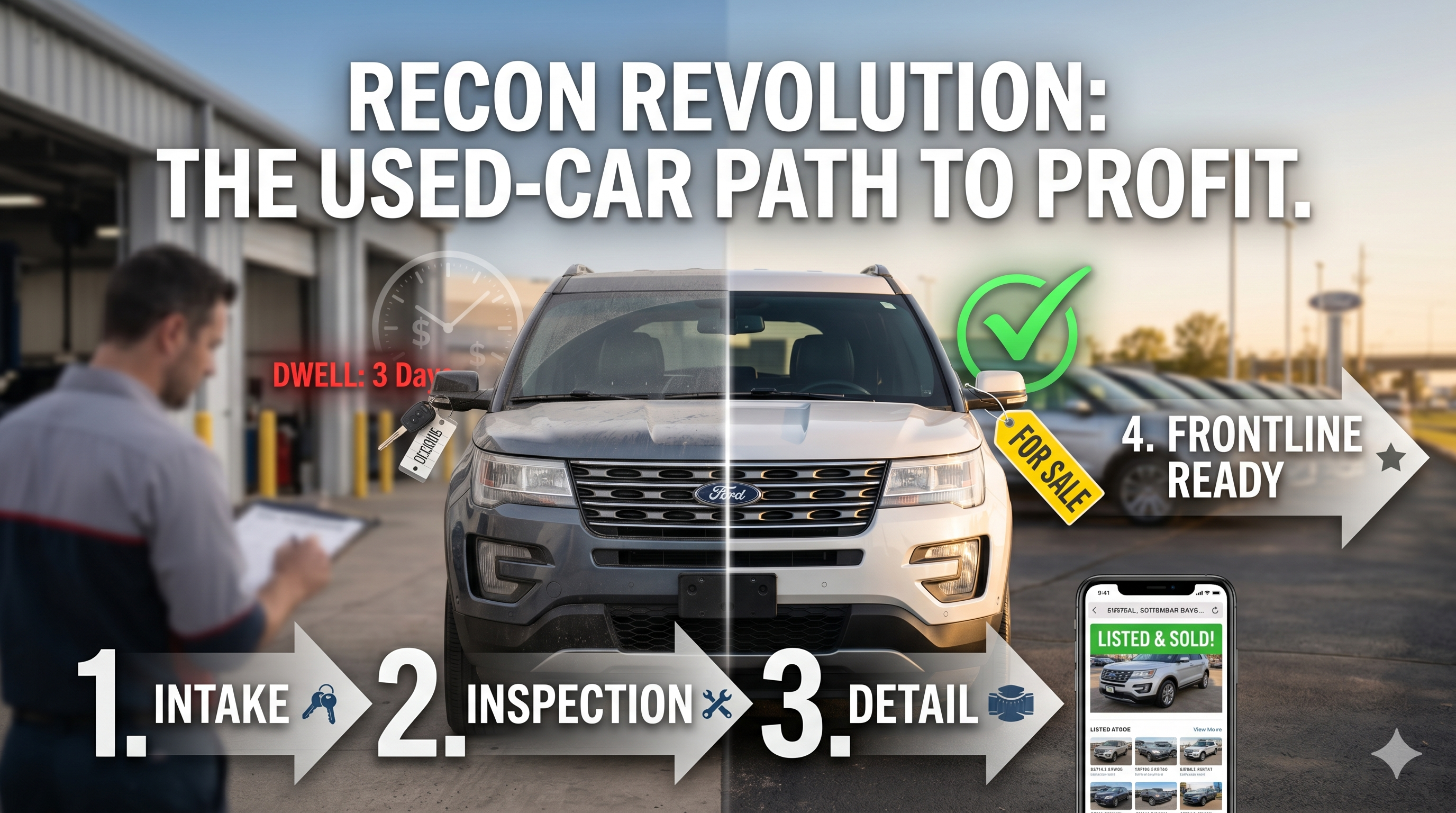
Every day a used car sits in recon, it costs you money. Somewhere between $40 and $85 in holding cost and depreciation, depending on whose numbers you trust. Multiply that across your inventory and the math gets ugly fast. The frustrating part is that most of those days aren't spent working on the car. They're spent waiting on it.
This is a complete breakdown of the used-vehicle reconditioning process. Every stage from intake to frontline, what actually happens at each step, and where the time really disappears. If you run a used-car department, manage a service drive, or you're trying to figure out why your time-to-line (T2L) is two weeks when the work is two days, this is the map.
What "reconditioning" actually means
Reconditioning (recon) is everything that happens to a used vehicle between the moment you acquire it and the moment it's frontline ready: priced, photographed, listed, and parked on the lot for sale. It covers safety inspection, mechanical repairs, body and paint, detail, vendor work, and merchandising.
People confuse recon with detailing or service work, but those are just single stages in the process. Recon is the whole assembly line.
The real problem: dwell time vs. touch time
Here's the distinction that separates dealers who turn inventory in 3 days from dealers who take 14.
Touch time is the time someone is actually working on the car: the tech doing the brake job, the painter blending a panel, the detailer running the buffer.
Dwell time is the time the car sits doing nothing. Waiting for approval, waiting on a part, sitting in a queue because nobody knows it's ready for the next stage.
On most lots, touch time is a fraction of the total. A car that takes 11 days to hit the line might have 6 hours of actual work in it. The other 10-plus days are dwell time, the gaps between the stages, not the stages themselves.
That's the whole game. The recon process isn't a list of tasks. It's a relay race, and the baton keeps getting dropped between runners. Keep that in mind as we walk the stages, because every handoff below is a place where a car can sit for two days while everyone assumes someone else has it.
The recon process, stage by stage
1. Acquisition and intake
The car arrives as a trade-in, auction buy, lease return, or off-street purchase. Intake is administrative but it sets the tone: keys tagged, stock number assigned, the vehicle logged into your system, initial photos taken.
The first real decision happens here. Retail or wholesale? Not every car earns a spot on your front line. A quick triage on condition and projected recon spend tells you whether this unit is worth retailing or whether it should go straight to auction. Getting this wrong, pouring recon dollars into a car you should have wholesaled, is one of the most expensive mistakes in the department, time and money wise.
Where time leaks: cars physically on the lot but never entered into the workflow. If it's not in the system, nobody's working it. It just sits.
2. Approval and recon authorization

The used-car manager reviews the work list and authorizes the spend. This single step is one of the biggest hidden bottlenecks in the entire process.
The work might be a two-hour job. But if the estimate is sitting in a manager's inbox, or worse, on a clipboard in the service drive, while they're tied up with a customer or off for the day, that car doesn't move. It's not unusual for a vehicle to lose one to two full days right here, waiting for a signature.
Where time leaks: approvals with no clock on them. Nobody owns the wait, so nobody feels it.
3. Parts
Once approved, parts get ordered. If everything's in stock, this is fast. If you're waiting on a back-ordered sensor or a panel from a regional warehouse, the car parks until it shows up.
Parts delays are partly outside your control, but the visibility around them usually isn't. Visibility into this step of the process allows you to call audibles and make adjustments on the fly, not a week later when you find out the car's already been waiting for parts.
Where time leaks: the gap between "approved" and "parts actually ordered," and parts that arrive but don't get matched back to the right car.
Pro-tip: this is usually a great time to get vendor work completed. If the car needs any interior work, wheel and curb rash repair, paintless dent repair, get it done now.
4. Mechanical reconditioning
The service department does the work: brakes, fluids, tires, safety items, whatever the approved list calls for. This is real touch time, and it's the part most people picture when they think recon.
The catch is that your used-car recon competes with paying customer ROs for the same techs and the same bays. Without a clear priority system, recon cars lose every time because retail customers are standing at the counter.
Where time leaks: recon work deprioritized behind customer pay, with no agreed rule for how the two share capacity.
Pro-tip: dedicate a couple of techs and bays specifically for recon work. After all, every service department's best customer is the used car department.
5. Body and paint
If the car has body damage or needs paint work, it heads to the body shop. In-house if you have one, sublet to a vendor if you don't. Vendor work introduces an external handoff, which means another place the car can disappear for days while it sits at a shop across town.
Where time leaks: sublet vendors with no shared timeline. The car is "at the body shop" and that's all anyone knows.
Pro-tip: external vendors don't usually feel the need to be accountable, and can sometimes stretch days out. Ask them for a timeline when you're giving them the car and hold them to it. Be sure to follow up if it's not done by then.
6. Imaging and merchandising
Photos, video, window sticker, online listing. This is where the car becomes a sellable asset on your website and the third party sites. A car that's mechanically frontline ready but un-photographed is still not actually for sale. It's invisible to every shopper online.
Where time leaks: the lag between "lot ready" and "listed." Cars sitting in the photo queue are cars buyers literally cannot find. You also have to consider time delays between feed updates from your IMS to your third party websites.
Pro-tip: if a car doesn't need any major body work and isn't filthy on the inside, snap a few quick pics once it's decided that the car will be a retail unit. Usually a minimum of 12 photos is good to ensure it gets ranked on your third party websites.
7. Frontline ready

The car is priced, listed, photographed, and parked on the front line. The clock stops. This is the finish line, the moment the unit can finally do its only job, which is sell.
Where your time-to-line really goes
Walk back through those stages and notice something. Almost every time leak was a handoff, not a task. Intake to inspection. Inspection to approval. Approval to parts. Mechanical to body. Body to detail. Detail to photos.
That's because the stages themselves are usually fine. Your techs are competent, your detailer is fast, your photographer takes good pictures. The breakdown is in the spaces between, the moments when a car is done with one stage and waiting to be picked up by the next, and nobody can see that it's stuck.
This total elapsed time, intake to frontline, is your time-to-line. It's the single most important number in a used-car operation, because it controls how fast capital recycles and how much depreciation you eat per unit.
How to tighten the process
You don't fix recon by working harder at the stages. You fix it by killing dwell time in the handoffs. That comes down to three things.
Visibility. Everyone, service, the used-car manager, detail, your vendors, should be able to see exactly where every car is, what stage it's in, and how long it's been sitting there. You can't fix dwell time you can't see.
Accountability. Every stage needs an owner and a clock. When a car has been waiting 36 hours on approval, someone should know, and it should be obvious whose move it is.
Automation of the handoffs. When mechanical finishes, detail should know automatically, not when someone happens to walk by and notice. Removing the manual "hey, is that car ready yet?" step is where the days come back. (See how it works.)
This is exactly the problem Cartuul was built to solve. Turning recon from a clipboard-and-text-message guessing game into a visible, accountable workflow where nothing sits in a handoff for two days because nobody knew it was there. It's the same system Mike Murphy Ford uses to manage roughly 800 vehicles in recon. (Read case study.)
Frequently asked questions
How long should the reconditioning process take? Best-in-class dealers hit frontline ready in 3 to 5 days. Many operations run 10 to 15. The difference is almost never the work itself. It's the dwell time between stages.
What's the difference between reconditioning and detailing? Detailing is one stage of reconditioning, near the end. Reconditioning is the full process from intake through mechanical, body, detail, and merchandising.
What is time-to-line? Time-to-line is the total elapsed time from when you acquire a vehicle to when it's frontline ready and listed for sale. It's the key performance metric for a recon operation.
Why does reconditioning take so long? Usually not because the repairs are slow. The lost time is in the handoffs: waiting on approvals, parts, and stage-to-stage transfers where a car sits with no owner and no clock.
Cartuul is a used-vehicle reconditioning workflow platform built inside a real dealership, for dealers. See Pricing or start a conversation about your recon process.