
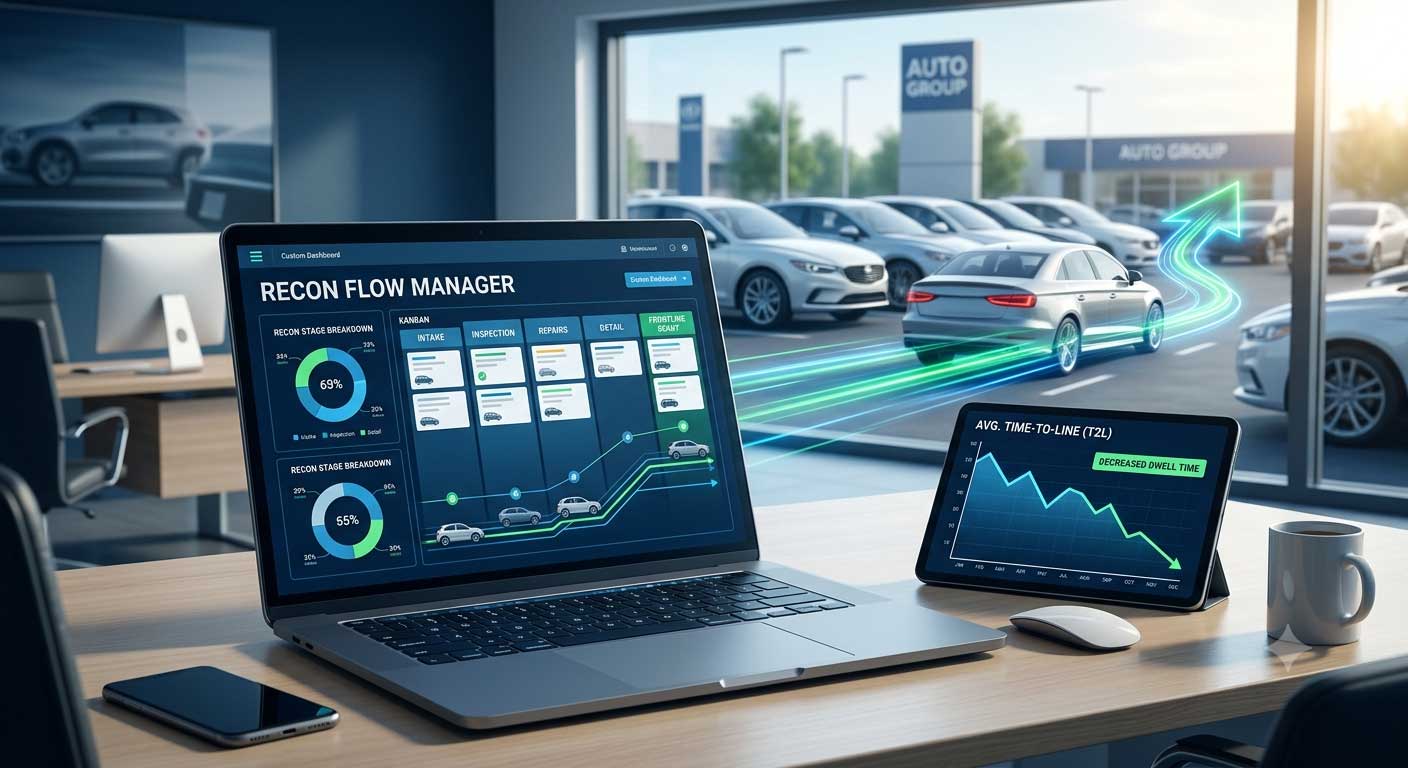
Open the website of any reconditioning software platform and you will read the same five promises: real-time visibility, customizable workflows, vendor communication, faster time-to-line, lower holding cost. Every one of them says it. Which is exactly why they are impossible to tell apart from the outside.
This is the honest version. We make one of these tools, so we have a side and we are not going to pretend otherwise. What we have done here is lay out the things that actually separate reconditioning software platforms once you get past the identical homepages, then show where the main ones land, including who each is genuinely the better call for. If that turns out not to be us for your store, you will know that too.
The short answer: the best reconditioning software depends on how your store runs. Rapid Recon fits larger stores that want a structured, step-by-step process. iRecon fits dealers already all-in on Cox and vAuto. Carketa fits stores that want recon bundled with appraisal and pricing in one suite. iPacket Recon fits dealers already using iPacket for merchandising. Cartuul fits stores that want execution, vendor accountability, and deep customization from a recon-first platform. The rest of this guide is how to tell which one is you.
If you want the groundwork first, start with the used-car recon process. This guide assumes you already know the days live in the waiting between stages, not the wrenching inside them.
Why every recon software website looks the same
The category has converged. Real-time tracking, drag-and-drop stages, holding-cost math on the homepage, a line about vendor communication. All of it is table stakes now. None of it tells you whether the software will actually move a car or just show you a prettier picture of it sitting.
The real differences are underneath the marketing. Here is where to look.
What actually separates reconditioning software platforms
Tracking versus executing. This is the big one. Almost every tool will tell you a car is stuck. Far fewer do anything about it. The question is whether the software dispatches the vendor, fires the next task, and forces the handoff, or whether it just lights up a red flag and waits for a human to notice. A status board is not the same as a system that moves cars.
Real vendor accountability. Most recon delay happens at the handoffs, and a lot of those handoffs go to outside vendors: glass, PDR, upholstery, sublet mechanical. Ask whether those vendors are actually in the system, assigned, and on the clock, or whether "vendor communication" means a notes field and a text message. If your vendors are invisible, you are blind exactly where cars sit longest.
Recon-deep versus suite-wide. Some platforms are reconditioning tools. Others are big suites where recon is one module bundled with appraisal, pricing data, sourcing, merchandising, and more. A suite can be great if you want all of that in one login. But if you want depth and options when it comes to your recon processes, find the one that allows you to customize your account on multiple levels.
Customization depth. Your store does not recon cars the way a vendor's default template says you do. Almost all reconditioning software will allow you to build out unlimited steps in your process, but that's one dimensional and even a simple spreadsheet can handle that. Very few will allow your account to be customized on multiple levels, run separate workflows for new and used, trigger events and automate movements, integrate with other systems your dealership is already using, and even set a different path for an individual vehicle. Rigid, fixed stages are a common complaint about the more locked-down tools.
Continuous improvements. Plenty of software companies ship a product and then only maintain it, fixing bugs and answering support tickets, but rarely making it meaningfully better. Far fewer keep improving the platform around real customer feedback. This matters most after an acquisition, because when a recon tool gets bought, the improvements often slow down and the product goes stale, fast. Worth knowing who is who here: the two oldest names in recon, Rapid Recon and ReconVelocity, are now both owned by Vehlo, and iPacket entered recon by acquiring ReconAdvisor. Acquisition is not automatically bad, but ask what has actually shipped since. Technology keeps evolving and so does the dealer landscape, and a tool that stops keeping up becomes an expensive whiteboard. The companies that keep innovating in their space win, almost every time.
Adoption. The best workflow on earth does nothing if your techs and managers will not touch it, so ease of use has to be immediate: the team should be able to pick up their piece on a phone, on the lot, in seconds. But do not confuse fast to start with fully dialed in. Molding the software to how your store actually runs takes iteration, weeks of tuning stages, triggers, and settings, and that tuning is normal, not stalled adoption. Be a little skeptical of any vendor who claims your entire custom workflow will be perfectly configured on day one. Getting the team using it fast is realistic. Getting every process perfect on day one usually is not.
Notice what is not on this list: price. We will get to why in a minute.
The main reconditioning software platforms in 2026
Rapid Recon
The platform that coined "time-to-line" and, by its own count, the most widely deployed, with thousands of dealerships using it. It is mature, it integrates with the major DMS platforms, and it leans on a team of performance managers who consult with your store.
Best for: larger stores and groups that want a simple, step by step process for their team to follow.
Watch for: dealers who have switched tell us the step-by-step bucket model can limit visibility when a vehicle needs multiple things done at once, since the car lives in one bucket at a time. It is also now one of two recon products under Vehlo, alongside ReconVelocity, so you are buying into a consolidated portfolio rather than an independent company. We wrote a deeper breakdown of why dealers switch from Rapid Recon if you want the full picture.
iRecon
iRecon is Cox Automotive's reconditioning tool, built to live inside the vAuto and Provision inventory stack so recon status shows up next to the inventory data you already manage there.
Best for: dealers already committed to the Cox and vAuto ecosystem who want recon data flowing alongside everything else.
Watch for: independent reviewers describe the workflows as rigid compared with standalone recon tools, with limited customization. It requires you to also have vAuto, so its value is highest when you are all in on Cox and drops if you are not.
Carketa
Carketa is an all-in-one suite that combines reconditioning with appraisal, market pricing, and sourcing, with unlimited users included.
Best for: stores that want recon, appraisal, and pricing in a single modern platform and like the idea of one suite for the whole used-car lifecycle.
Watch for: reconditioning is one module in a broader suite, so you are adopting more than just recon. Reviewers also note the interface can feel busy at first and that getting full value from the reporting takes some training. If recon is the only thing you are trying to fix, a recon-first tool may be a cleaner fit.
iPacket Recon
iPacket is best known as a digital vehicle presentation and merchandising company used by thousands of dealers. It entered reconditioning in 2024 by acquiring ReconAdvisor and rebranding it iPacket Recon: a customizable, queue-based recon workflow with vendor self-management, DMS integration, and vehicle-history data built in.
Best for: dealers already running iPacket for merchandising and window stickers who want recon living in the same house, tied to the sales presentation.
Watch for: recon is a newer, secondary line for iPacket, added by acquisition, on top of a business built around sales presentations. If recon is your core problem, weigh how central it really is to their roadmap.
Cartuul
Cartuul was built by an operator who ran reconditioning at high-volume stores for 17 years, after nothing on the market fit the way recon actually works. It is recon-first and execution-first: real-time visibility, vendor accountability built in (you invite vendors into the platform with access to only their tasks), a workflow builder deep enough for separate new and used paths and even per-vehicle workflows, per-vehicle AI tips, a built-in VIN scanner, and 35-plus integrations across DMS, IMS, CRM, key boxes, photo and inspection platforms, and parts. Cartuul reports most dealers see a meaningful cut in time-to-frontline within the first 90 days.
Best for: franchise and independent stores, BHPH lots, and groups that want execution and accountability over a dashboard, deep customization, and a team that answers the phone. Real people, not tickets.
Watch for: Cartuul is newer and founder-led compared with the incumbents. You are betting on a fast-moving company that ships and supports quickly rather than a legacy brand. For a lot of operators that is the point. For some it is a reason to wait.
Do not choose reconditioning software on price
Pricing in this category is all over the map, flat plans, per-vehicle fees, per-seat charges, suite bundles, and it changes often enough that any number printed here would be stale by the time you read it. More to the point, price is the wrong thing to lead with.
The wrong tool is expensive at any price, because cars keep sitting. The right tool pays for itself in the days it takes off your time-to-line, days that are costing you real money every single one they tick by. Pick the platform that fits how your store actually runs and that your team will actually use. Get that right and the ROI takes care of the price.
How to choose
It comes down to fit. If you are a large group standardized on Cox and vAuto, iRecon's ecosystem tie-in is hard to ignore. If you want the most established name, Rapid Recon has the longest track record. If you want recon, appraisal, and pricing in one modern suite, Carketa is worth a demo, and if you already live in iPacket for merchandising, its recon module keeps everything under one roof. And if your real problem is execution, accountability, and visibility, with deep customization and continuous improvements built on your feedback, that is the exact gap Cartuul was built to fill.
| Platform | Best for | Watch for |
|---|---|---|
| Rapid Recon | Larger stores and groups wanting a simple, structured step-by-step process | Bucket-based model dealers say limits visibility for the team and vendors |
| iRecon | Dealers committed to the Cox and vAuto ecosystem | Rigid workflows and limited customization; requires vAuto |
| Carketa | Stores wanting recon, appraisal, and pricing in one suite | Recon is one module; interface and reporting take ramp-up |
| iPacket Recon | Dealers already using iPacket for merchandising | Recon is a newer line, added by acquiring ReconAdvisor |
| Cartuul | Stores wanting execution, accountability, and deep customization | Newer and founder-led versus the incumbents |
Frequently asked questions
What does reconditioning software actually do?
It tracks every vehicle from acquisition to frontline-ready, assigns and automates the tasks and vendor handoffs at each stage, and shows you where cars are stuck. The good ones execute the handoffs instead of just displaying status, which is where the time savings actually come from.
What is the best alternative to Rapid Recon?
It depends on why you are leaving. If the bucket model or adoption is the problem, a recon-first platform with parallel workflows and vendor accountability, like Cartuul, is the closest fit. We broke down the switch in detail in our Rapid Recon alternative guide.
How much does reconditioning software cost?
Models vary widely: flat monthly plans, per-vehicle fees, per-seat charges, and suite bundles. Whatever the model, the cost of the software is small next to the holding cost of cars sitting extra days in recon, so pick on fit and adoption first. The right tool pays for itself in reduced time-to-line.
What should I look for in a reconditioning software demo?
Bring your real process. Ask the vendor to build your actual stages, show a car needing two things at once, dispatch a real outside vendor, and demonstrate what happens automatically when a task completes. If the demo only shows dashboards, you learned nothing about execution. Our guide to what to look for in reconditioning software has a demo test for every feature that matters.
The bottom line
The best reconditioning software is the one your team will actually use to move cars, not just watch them sit. Set your own criteria before you sit through a single demo: does it execute or just track, are vendors and the team really held accountable, can you shape the workflow to your store, and will the team adopt it. Hold every option to that standard, ours included.
If you want to see what execution and vendor accountability look like on your own inventory, book a Cartuul demo and we will walk your store, your steps, your vendors.